-Legal Options for U.S. Permanent Residents to Obtain a Green Card for Their Newborn (2025 Guide)
By Wang Law LLC — Immigration Attorneys
Chicago & Montreal Offices
I. Introduction
Many lawful permanent residents (LPRs) live, work, or travel abroad during pregnancy. If your child will be born outside the United States, you must understand that a baby born abroad to U.S. permanent residents does NOT automatically become a U.S. citizen or a green card holder.
Unlike children of U.S. citizens, children of LPRs do not acquire automatic status.
To bring your child to the United States, you must complete the family-based immigrant visa process through the F2A category or, in limited cases, use follow-to-join (INA §203(d)). This guide explains:
- Your legal options as LPR parents
- How F2A works for newborns born abroad
- What changes if one parent later becomes a U.S. citizen
- Timeline and government fees
- December 2025 Visa Bulletin impact
- Practical considerations for families expecting a child overseas
II. Children Born Abroad to LPRs Do Not Automatically Acquire Status
Under INA §§301–309, automatic citizenship applies only to children born abroad to U.S. citizens.
If both parents are lawful permanent residents at the time of the child’s birth:
✔ The child does NOT become a U.S. citizen
✔ The child does NOT automatically receive a green card
✔ The child MUST go through the immigrant visa process
The applicable category is:
F2A — Children (Under 21) of Lawful Permanent Residents
III. Step-by-Step Process for Obtaining a Green Card for Your Child Born Abroad
This process applies whether your child is born in China, Canada, Europe, Southeast Asia, Latin America, Africa, or the Middle East.
Step 1 — File Form I-130 (Petition for Alien Relative)
Required Documentation
- Copies of parents’ green cards
- Child’s foreign birth certificate + certified translation
- Marriage certificate (if applicable)
- Evidence of the parent-child relationship
- Parent passports
- Filing fee
2025 USCIS Fee
- I-130 online: $625
- I-130 paper: $675
Processing Time: 6–12 months (no Premium Processing available)
Note: You may request a USCIS expedite, but expedite cannot override visa availability or move the priority date.
Step 2 — National Visa Center (NVC) Processing
After I-130 approval, the case moves to NVC. Requirements include:
- DS-260 immigrant visa application
- I-864 Affidavit of Support
- Parent’s tax returns & W-2s
- Birth certificate
- Passport
- Civil documents
Government Fees
| Fee | Amount |
|---|
| AOS Fee | $120 |
| IV Fee | $325 |
| USCIS Immigrant Fee | $235 |
Estimated Total: $1,280 – $1,705 including medical exam.
Step 3 — Immigrant Visa Interview at U.S. Embassy/Consulate
The interview occurs in the country of birth or residence, such as:
- Guangzhou
- Montreal
- London
- Singapore
- Abu Dhabi
- Mumbai
- Ciudad Juárez
- Sydney
- Etc.
Your child becomes a lawful permanent resident upon entry to the United States.
IV. Timeline for LPR Parents Expecting a Baby Overseas
Typical Timeline (No Expedite)
| Stage | Time |
|---|
| USCIS I-130 | 6–12 months |
| NVC Processing | 2–4 months |
| Embassy Interview Wait | 2–6 months |
| Entry to U.S. → Green Card | immediate LPR |
| Total | 12–22 months |
Expedited I-130 (If Approved)
| Stage | Time |
|---|
| I-130 Approval | 5–10 days |
| NVC Expedite | 1–4 weeks |
| Interview | 1–2 months |
| Total (best-case) | 2–4 months |
⚠ Important: Expedite approval does NOT eliminate Visa Bulletin wait time if your priority date is later than the Final Action Date.
V. December 2025 Visa Bulletin: The Real Bottleneck
F2A Final Action Date — Worldwide (Including China-mainland)
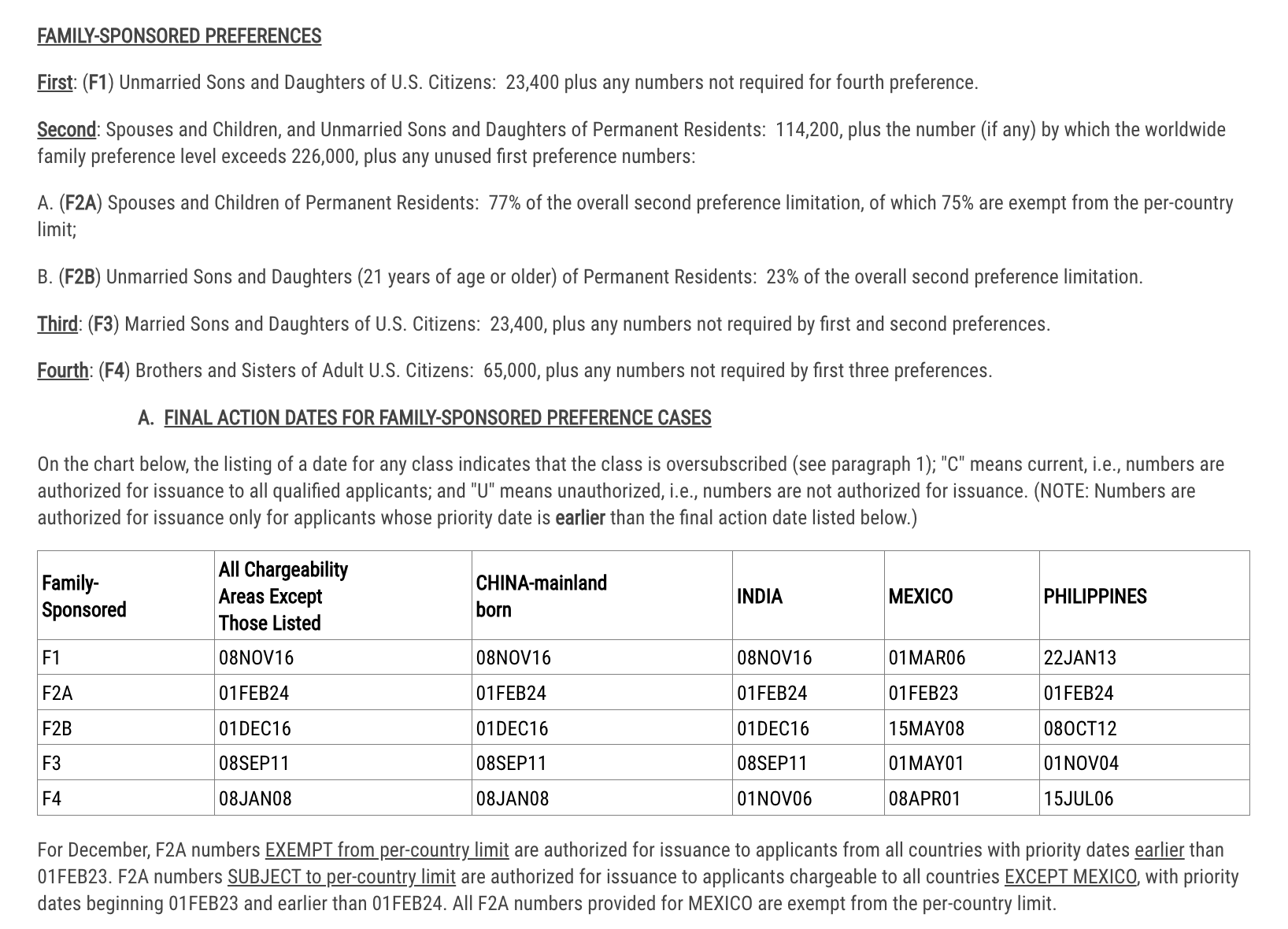 #December 2025 Visa Bulletin
01 February 2024
What This Means
Only children whose priority date (I-130 filing date) is earlier than 01 FEB 2024 may be issued an immigrant visa now.
If you file I-130 in:
- 2025 → PD = 2025
- 2026 → PD = 2026
Those priority dates are later than the current FAD (2024/02/01).
Therefore:
❌ Your child must wait for the Visa Bulletin to advance to their priority date.
❌ Even with I-130 expedite, no visa can be issued until PD becomes current.
This is the single most important fact LPR parents must understand.
VI. What If One Parent Becomes a U.S. Citizen Later?
This is where things change significantly — and sometimes dramatically.
A. If the Parent Naturalizes Before the Child Is Born
Huge difference! A child born abroad to a U.S. citizen parent may qualify for:
1. CRBA — Consular Report of Birth Abroad
(If parent meets physical presence requirement)
If approved → child becomes a U.S. citizen at birth.
No I-130 needed.
No visa needed.
No green card needed.
Requirements
- U.S. citizen parent lived in U.S. for 5 years, including 2 years after age 14
(For married parents; there are alternative rules for unmarried parents)
B. If the Parent Becomes a U.S. Citizen After the Child Is Born but Before Age 18
This creates two possible benefits:
1. IR-2 Category (Immediate Relative)
- No Visa Bulletin wait
- No quota limits
- Processing is significantly faster
- You file I-130 → immediate eligibility upon approval
Even if PD is far behind the F2A Final Action Date, conversion to IR-2 wipes out the backlog.
2. Automatic Citizenship Under INA §320 (for children in the U.S.)
A child automatically becomes a U.S. citizen if:
- One parent becomes a U.S. citizen
- The child is a permanent resident
- The child is under 18
- The child resides in the U.S. in the legal and physical custody of the citizen parent
If the child is still abroad → INA §320 does not apply, but IR-2 remains available.
C. What If Both Parents Later Naturalize?
Even easier.
Under IR-2:
- No priority date wait
- No visa backlog
- No F2A quota limit
- Immediate consular processing upon I-130 approval
VII. Summary of Options (LPR vs. U.S. Citizen)
| Parent Status at Child’s Birth | Child’s Status |
|---|
| Both parents are LPRs | Child is not U.S. citizen; must apply through F2A |
| One parent is U.S. citizen BEFORE birth | Child may be U.S. citizen at birth (CRBA) |
| One parent becomes U.S. citizen AFTER birth | Child becomes IR-2 → no waiting line |
| Child enters U.S. as LPR and lives with U.S. citizen parent | Child may acquire automatic citizenship under INA §320 |
VIII. Attorney Guidance for Families Expecting a Baby Abroad
If you remain green card holders:
- Expect 1–2 years of Visa Bulletin waiting
- Plan documentation early
- Consider expedite only for emergencies
- Start I-130 immediately after birth
If one parent may naturalize soon:
- Naturalize before birth if possible → CRBA (best outcome)
- Naturalize after birth → IR-2 (no backlog)
IX. Contact Us
Wang Law LLC assists families worldwide with:
- Green card and citizenship planning for overseas births
- I-130 filings (F2A & IR-2)
- Follow-to-join eligibility analysis
- CRBA (Consular Report of Birth Abroad) guidance
- NVC processing and embassy interviews
- I-864 compliance
- Strategic planning for parents seeking naturalization
- Humanitarian or expedite requests
📞 312-519-1115
📧 info@wanglaw.com
🌐 www.wanglaw.com